
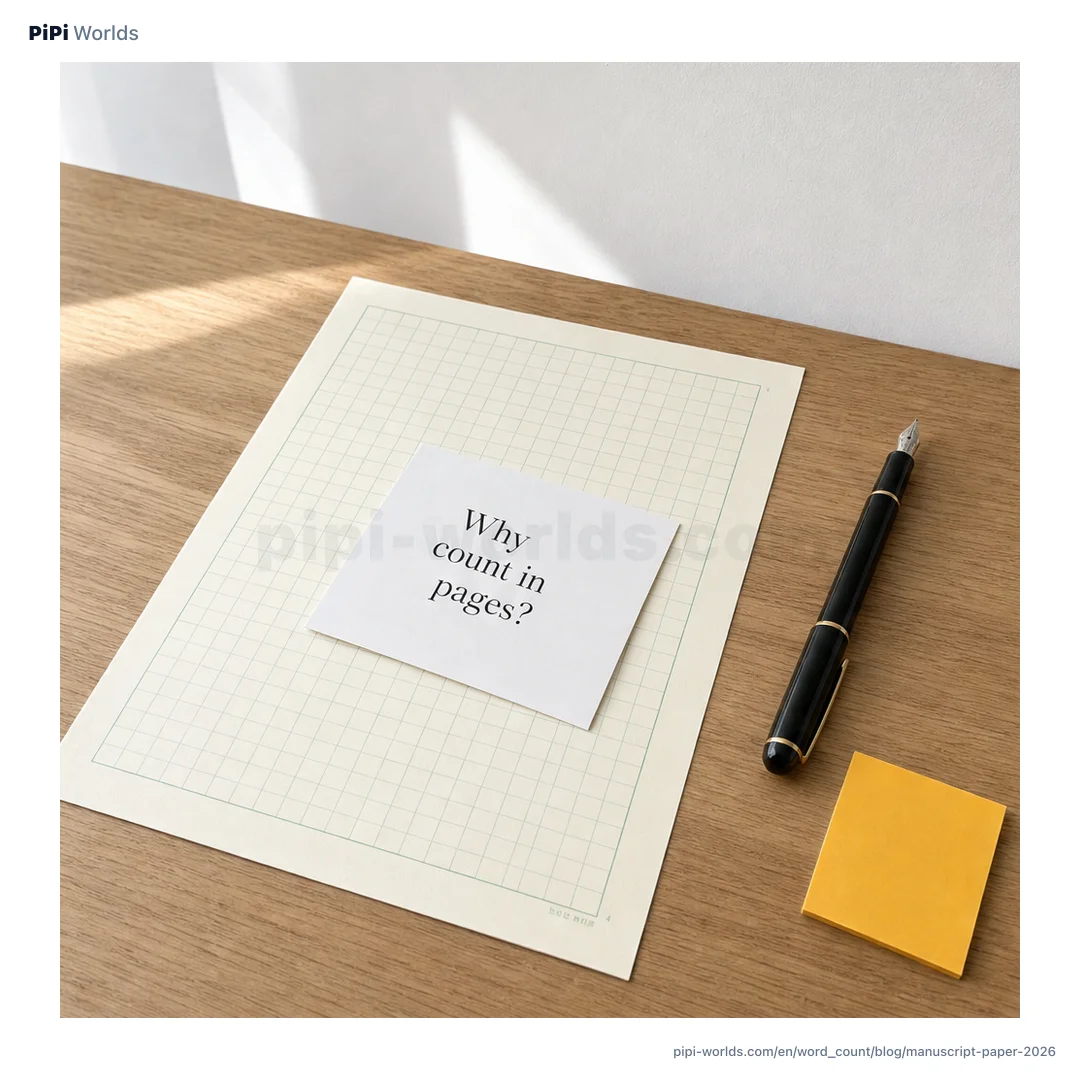
When I lived in Tokyo, a Japanese friend who edited literary fiction told me her authors still submitted novel-length contracts denominated in pages — not words, not characters, but manuscript pages of exactly 400 characters each. She handed me one of the standard ruled sheets, light-green grid printed on cream paper, twenty squares across by twenty squares down. “Three hundred of these for a Naoki Prize submission,” she said, holding the single sheet up to the office light. “About a thousand for a long novel.” I’d never thought about how unusual it was — and how useful — to have a writing unit that existed independently of font and margins. English-language publishing has a similar shadow system in “12-point Times New Roman, double-spaced, one-inch margins,” but it’s never as clean as a 400-character grid that doesn’t budge regardless of how you choose to render it.
The Japanese 20-by-20 grid
Japanese standard manuscript paper — genkō yōshi (原稿用紙) — has a fixed grid of twenty characters across by twenty lines down, totaling 400 characters per page. The grid is what makes the page a unit. One character per cell, one cell as one unit of length, twenty cells per line, twenty lines per page, four hundred per sheet. Writers using these sheets fill in roughly one cell per character, including punctuation and small kana, with specific rules for how to handle line-end punctuation (kinsoku-shori) and quotation marks (which often span two cells, kakko).
The Japanese-language Wikipedia entry on 原稿用紙 traces the 20-by-20 standard back to the printing blocks (hangi) used by Hanawa Hokiichi for his Edo-period anthology ‘Gunsho Ruiju.’ Carving Chinese characters into wood required them to be large enough to read but small enough to fit a useful amount of text per block. Twenty by twenty turned out to be the practical balance. When Meiji-era publishers transitioned to movable type and needed a standardized manuscript format for authors, they adopted Hokiichi’s grid, and it has remained the Japanese standard for more than 125 years.
The Korean 20-by-10 grid — half the size, same DNA
Korean standard manuscript paper (원고지) has a 20-by-10 grid for 200 characters per page, exactly half the Japanese version. The format diverged during the late colonial period and was solidified in postwar Korean academic and publishing institutions, where 200 characters per page was treated as a more granular unit for teaching writing — easier for students to fill, easier to assign in small increments, and tied to a more compact educational rhythm.
The relationship between the two formats is direct. The same 1,000-character text is “5 pages” in Korean conventions and “2.5 pages” in Japanese conventions. Writers who work in both languages develop an intuitive sense that Korean page counts roughly double Japanese page counts for the same content. Korean academic journals often specify “본문 100매 내외” (about 100 pages) for a paper, which means about 20,000 characters — roughly equivalent to a 7,000-word English article.
What “100 pages” means in different contexts
Manuscript page units appear most commonly in Japanese contexts. A few useful reference points across genres:
- Elementary school book reports: 2 to 5 pages (800 to 2,000 characters)
- High school book reports for the national contest: 5 pages (2,000 characters)
- University essays and short papers: 5 to 10 pages (2,000 to 4,000 characters)
- Bachelor’s thesis (humanities): 50 to 100 pages (20,000 to 40,000 characters)
- Master’s thesis (humanities): 200 to 400 pages (80,000 to 160,000 characters)
- Akutagawa Prize entries (short to medium literary fiction): 30 to 200 pages
- Naoki Prize entries (medium to long popular fiction): 200 to 700 pages
Translating these into a more familiar unit for English readers: a 100-page Japanese novel is about 40,000 characters, which corresponds in print to roughly 60 pages of a Japanese paperback. In English equivalents, 40,000 characters of Japanese is approximately 16,000 English words — about a long magazine article or a novella. So the Akutagawa Prize, when it considers works “as short as 30 manuscript pages,” is considering works as short as 12,000 characters or roughly 4,800 English words.
Cross-language conversion ratios
For writers translating between Japanese and English, a useful approximate conversion ratio is:
- 1 English word ≈ 2.5 Japanese characters (non-fiction prose)
- 1 English word ≈ 2.2 Japanese characters (fiction with dialogue)
- 1 English word ≈ 2.7 Japanese characters (academic and technical prose)
Using these ratios, a 7,000-word English article translates to approximately 17,500 Japanese characters, which fits in 44 manuscript pages. A 100,000-word English novel translates to approximately 250,000 Japanese characters, or 625 manuscript pages — solidly in Naoki Prize territory.
The ratios are approximate. Japanese tends to compress dialogue (single particle endings carry tone that English needs whole sentences to convey) and tends to expand context (Japanese readers often expect more setup before action). The net effect varies by genre and translator, but for length budgets the 2.5x ratio works well enough.
For Korean to English, the conversion runs slightly differently — Korean syllables are denser than Japanese characters in information content, but Korean prose uses more spaces. A reasonable approximate ratio is 1 English word ≈ 2.0 Korean syllables, so the same 7,000-word English article corresponds to roughly 14,000 Korean syllables, or 70 Korean manuscript pages (200 syllables each).
A4 to manuscript pages
Modern Japanese writing happens almost entirely in word processors, and the question of “how many A4 pages is 100 manuscript pages” comes up constantly in academic and publishing settings. The answer depends on font size, line spacing, and margins, but useful baselines:
- MS Word default (10.5pt Mincho, 40 chars × 40 lines per page): 1 A4 page ≈ 4 manuscript pages
- Academic paper standard (11pt, 40 × 35, 1.2 line spacing): 1 A4 page ≈ 3 manuscript pages
- Comfortable reading (12pt, 1.5 line spacing, generous margins): 1 A4 page ≈ 2 manuscript pages
So a 100-page manuscript thesis is roughly 25 to 50 A4 pages depending on formatting, with 33 A4 pages being a typical mid-point. Korean conventions follow a similar pattern but at half the manuscript-page count: a 100-page Korean academic paper (200-character pages) corresponds to roughly 12 to 18 A4 pages.
Why the unit persists in 2026
It would be easy to assume that “manuscript pages” are a fossil from the era before computers. In practice, the unit persists because it solves a real problem: text density varies enormously with formatting, and contract terms need a font-independent measure of how much text is actually involved.
Japanese university theses are still set in manuscript pages. Literary prize submission rules are still expressed in pages. Major publisher contracts still denominate advances and royalty thresholds in pages. Microsoft Word’s Japanese version, like the Korean version, includes “manuscript page count” alongside word and character counts as a default statistic. The English-language Wikipedia entry on Genkō yōshi describes the same continued institutional use.
The English-speaking world has its own version of this problem — the imprecise convention “double-spaced, 12-point, one-inch margins, about 250 words per page” used in screenwriting and novel manuscript submissions. But that convention is much weaker because the underlying unit (page) depends on factors the writer controls. Manuscript pages don’t have that flaw. The grid is the unit. Every cell is one character. Every page is exactly 400 characters in Japanese, exactly 200 in Korean. The unit doesn’t move when the format changes.
Tools that show all three numbers
PiPi Worlds’s word count tool shows characters, characters without spaces, words, lines, reading time, manuscript pages at 400 characters (Japanese), and manuscript pages at 200 characters (Korean) live as you type. The point of showing all three is so that translators, dual-language editors, and students writing for different academic conventions don’t have to do the conversion math in their heads. A 5,000-word English article that needs to be expressed in Japanese manuscript pages, in Korean manuscript pages, and in characters can be checked in one place without retyping anything.
Closing — manuscript paper as a contract for length
Manuscript paper is, in the end, a small but elegant solution to a problem most languages have never quite solved. Japanese and Korean publishing settled on a unit that doesn’t depend on the writer’s choices about how to format the text — it depends only on the text itself, character by character, fitting into a fixed grid. That stability is what makes it useful in contracts, prize rules, and academic regulations. When you read that an Akutagawa Prize entry can be 30 manuscript pages, or that a Korean academic paper should be about 100 manuscript pages, or that a literary translation contract specifies a 250-page novel, the page count is doing the same work that “12,000 characters” or “20,000 characters” or “100,000 characters” would do — but with the added property of being meaningful regardless of how the manuscript is rendered. It’s a small piece of analog technology that quietly survives the digital era because it’s still doing useful work.