
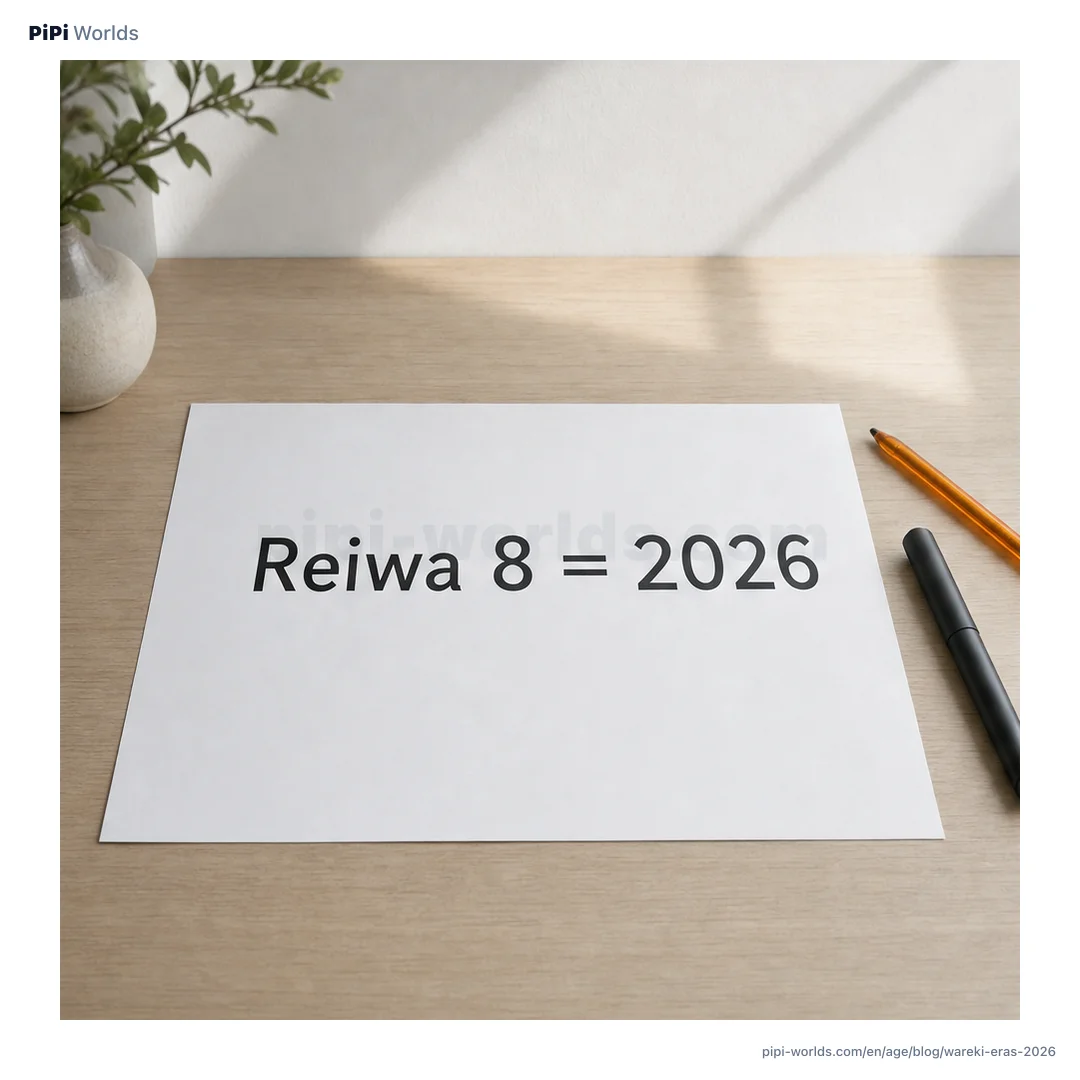
If you’ve spent any time around Japanese paperwork — visiting Japan, marrying into a Japanese family, or simply receiving a birthday card from a Japanese friend — you’ve likely encountered the question “What year was that in Western terms?” Japan still uses imperial era names alongside Western years on virtually every official document, from driver’s licenses to health insurance cards. Reiwa year 8 is 2026. Heisei 31 was 2019. Showa 63 was 1988. The conversion is mechanical once you know the formulas, but the cultural practice behind these era names is what makes Japan unique among modern nations.
The five modern Japanese eras
Japan has used era names continuously for over 1,300 years, but only the five most recent are commonly encountered today.
| Era (Kanji / Romaji) | Start date | Conversion formula | Last year |
|---|---|---|---|
| Meiji 明治 (M) | Jan 25, 1868 | + 1867 | M45 = 1912 |
| Taisho 大正 (T) | Jul 30, 1912 | + 1911 | T15 = 1926 |
| Showa 昭和 (S) | Dec 25, 1926 | + 1925 | S64 = 1989 |
| Heisei 平成 (H) | Jan 8, 1989 | + 1988 | H31 = 2019 |
| Reiwa 令和 (R) | May 1, 2019 | + 2018 | (current) |
The Meiji era kicks off Japan’s modern history (the Meiji Restoration ended the Edo period and rapidly modernized Japan). Taisho was a period of brief democratic experimentation. Showa covered World War II and the postwar economic miracle. Heisei was the “lost decades” following Japan’s economic bubble. Reiwa, started in 2019, has so far been defined by COVID-19, the Tokyo Olympics, and a slow demographic transition.
The Reiwa era’s unusual start
Most Japanese era changes have happened at imperial death — the new era begins with the new emperor’s enthronement, which usually follows immediately after the previous emperor’s passing. Reiwa was different.
On April 30, 2019, Emperor Akihito formally abdicated (the first imperial abdication in nearly 200 years). On May 1, 2019, his son Emperor Naruhito ascended the throne, and the Reiwa era began. This means a single calendar year (2019) contained two eras: Heisei 31 from January 1 to April 30, and Reiwa 1 from May 1 to December 31.
For practical purposes, this affects:
- People born April 30, 2019 are recorded as Heisei 31 in family registers
- People born May 1, 2019 are recorded as Reiwa 1
- Driver’s licenses issued before May 1, 2019 still show Heisei dates; renewals after May 1 show Reiwa
- Documents that span the boundary (school transcripts, employment records) often have mixed era notation
Era boundaries with very short final years
Several Japanese eras have unusually short last years because of the timing of imperial death.
- Showa 64: January 1-7, 1989 (just 7 days, ending with Emperor Hirohito’s death)
- Heisei 31: January 1 - April 30, 2019 (4 months, ending with Akihito’s abdication)
- Taisho 15: January 1 - December 24, 1926 (Hirohito ascended December 25)
- Meiji 45: January 1 - July 29, 1912
The Showa 64 case is particularly striking. Emperor Hirohito died at 6:33 AM on January 7, 1989, and Heisei began the next day. So “Showa 64” is technically a real era year, but only seven days long. People born during those seven days have a uniquely brief era designation.
Why Japan still uses imperial eras
In an age of global standardization, why hasn’t Japan moved fully to Western years? Several reasons:
- Imperial system identity: Japan’s emperor is the symbol of state continuity. Era names are the most visible expression of imperial cultural function.
- Document infrastructure: Massive systems (legal, medical, financial, religious) are built around era dating. Migrating away would cost billions and provide minimal practical benefit.
- Cultural connection: Many Japanese citizens express their birth year in imperial era form (“Showa 53”) rather than Western (1978). The era marker carries social-historical context that the Western year doesn’t.
- Religious and traditional industries: Shrines, temples, traditional crafts (lacquerware, calligraphy, tea ceremony) use era names exclusively in formal documents and dating.
The Cabinet Office and Imperial Household Agency have shown no indication of phasing out era usage. Computer systems support both imperial and Western dating, and most Japanese citizens fluently switch between the two.
A practical conversion shortcut
If you remember just three numbers, you can convert most documents you’ll encounter:
- Reiwa: add 2018
- Heisei: add 1988
- Showa: add 1925
For example, “Showa 53” = 53 + 1925 = 1978. “Heisei 12” = 12 + 1988 = 2000. “Reiwa 8” = 8 + 2018 = 2026.
For older eras (Meiji, Taisho), the formulas are similar but less commonly needed unless you’re researching historical documents or family genealogy. Most living Japanese were born in Showa, Heisei, or Reiwa.
Worked example: one family across three eras
Walking three birthdays from the same family through the conversion shows exactly where the formula gets tricky:
- A parent born May 1988 →
Showa 63. Using Western − 1925 = era year, 1988 − 1925 = 63. - A child born April 30, 2019 →
Heisei 31. 2019 − 1988 = 31. - A sibling born May 1, 2019 →
Reiwa 1. 2019 − 2018 = 1.
The last two were born one day apart, yet they fall into different eras. May 1, 2019 was the kaigen (改元) date — the day the era officially changed — so April 30 is the final day of Heisei and May 1 is the first day of Reiwa. The same trap appears at the Showa→Heisei boundary: a baby born January 5, 1989 is Showa 64, but one born January 8, 1989 is Heisei 1, even though both birth certificates read “1989” in Western terms. Knowing the offset alone isn’t enough — you also have to know which side of the boundary date a birthday lands on.
”What era was I born in?” — settle it in one second
The real question this article keeps circling back to is simple: when you hit an era name on a Japanese form, or when a Japanese friend asks what era you were born in, you need to know exactly which Japanese era your own birth date falls into. Memorizing the offsets gets you most of the way — but the kaigen boundary dates (January 8, 1989 and May 1, 2019) are where people guess wrong.
The age tool takes a date of birth and shows the matching Japanese era automatically — and it splits the boundary dates for you. Enter January 5, 1989 and it returns Showa 64; enter January 8, 1989 and it returns Heisei 1, even though both are “1989” in Western terms. No mental arithmetic, no guessing which side of the era change a birthday lands on.
The Korean (/ko/age) and Japanese (/ja/age) versions run the same calculation, with the Japanese page showing the imperial era as the primary display. Useful when filling out Japanese government forms, planning a trip to Japan, or working out what era your Japanese-American grandparent was born in.
The Japanese era system is one of the few remaining ways the modern world dates time differently from the Gregorian standard. It’s a living connection between the imperial institution, daily paperwork, and individual identity. Knowing the conversion formulas is a small skill that pays off whenever Japan’s bureaucracy, history, or culture comes into your life.