


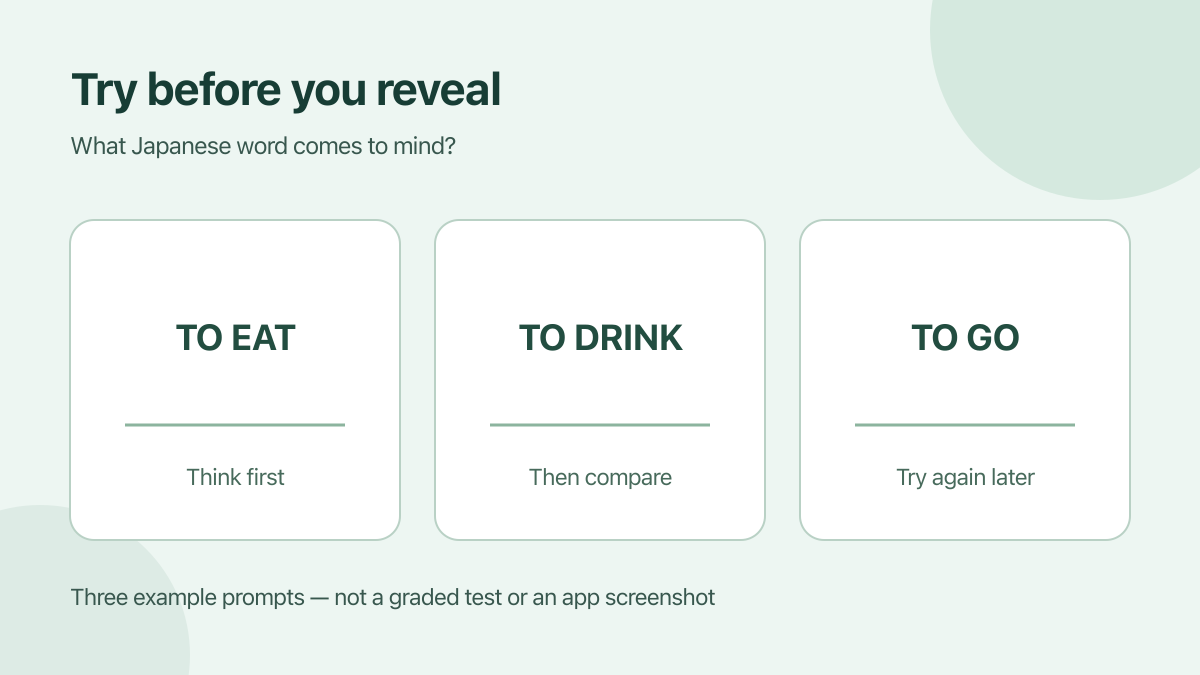
Seeing 飲む and choosing “to drink” is one task. Seeing “to drink” and producing 飲む or のむ without choices is another. Try the second task before deciding what you need to practise. This page offers three small checks, not a memory diagnosis or a promise that a study method will work for everyone.
Prefer a blank space? Write or type a Japanese word in the separate free example. It uses “water”, not these three verbs. Reveal its reference and compare it yourself. It needs no install or sign-up and does not grade your answer or update app study records.
Three verbs: try before you reveal
For each English prompt, say or write a Japanese dictionary-form verb. Try its kana reading too. Do not open the reference until you have attempted an answer. If you have not learned these words yet, read the table below first: a blank answer is not evidence of poor memory.
To eat — reveal one reference
食べる · たべる (taberu). Example: 朝ごはんを食べる。 — To eat breakfast.
To drink — reveal one reference
飲む · のむ (nomu). Example: 水を飲む。 — To drink water.
To go — reveal one reference
行く · いく (iku). Example: 学校に行く。 — To go to school.
These references are not automatically graded and are not the only possible expressions in Japanese. They are the specific three verbs used in this exercise. If you answered たべる rather than 食べる, distinguish recalling a reading from writing the kanji; do not merge those into a single “I know it” score.
Compare the word, reading and short phrase
The references below match three cards in our current Japanese web sample. Hide the Japanese columns or close the disclosures when trying again.
| English prompt | Word | Reading | Sample phrase | English reference |
|---|---|---|---|---|
| to eat | 食べる | たべる | 朝ごはんを食べる。 | To eat breakfast. |
| to drink | 飲む | のむ | 水を飲む。 | To drink water. |
| to go | 行く | いく | 学校に行く。 | To go to school. |
Ask three separate questions: Did the word come to mind before the reference? Could I produce its reading? Can I connect it with the short phrase? You can keep your own note on paper. This page does not collect an answer or record a result. Producing one dictionary form also does not demonstrate speaking, listening or grammar proficiency.
What the four-choice quiz can tell you
The free cards and four-choice quiz use a twelve-word sample per selected deck and five randomly selected questions. In the default Japanese deck, you see a Japanese word and choose its English meaning. Choices can cue the answer. A correct selection is not evidence that you can produce Japanese from English or recall it on a later day.
After a mistake, the quiz shows the correct meaning and example. At the end you can retry only the missed words; the retry score stays separate from the first score. That is another check within the current session, not a delayed-memory test. A new quiz, level, learning direction, mode or reload clears it.
Hard collects hard cards to revisit after this pass; Good and Easy move on. These temporary ratings are not a correct-answer score. Restarting or changing the level, language direction or mode clears them. The web preview does not save a long-term schedule or calculate your next review date. Your web answers, progress and writing are not saved or transferred to the app; refreshing clears it. Trying the three English prompts here is a separate exercise, not a hidden new quiz mode.
Why try again later, rather than only reread?
Karpicke and Roediger’s foreign-language vocabulary experiment compared what happened after students first produced a correct answer. Its abstract reports better later recall when testing continued than when only studying continued. That supports trying to produce an answer again; it does not establish the effect of this three-verb page or the site’s multiple-choice quiz.
Cepeda and colleagues’ review found that the useful gap between learning occasions depended partly on how long it was until the final memory check. A single timetable cannot be lifted from that finding for every learner and word. These are not tests of this page, our app or JLPT performance. We have not measured how much either web exercise improves learning.
A practical later check is simple:
- After reading the references, close them and do something else.
- On a later day, try the same three English prompts before opening any answers.
- Compare the word, kana and phrase separately. Recheck what was missing; if everything is unfamiliar, learn fewer items first.
A later day is an example, not a prescribed optimal schedule. There is no need to predict an exact moment when you will forget. Use Save for later above, then reopen the guide from your saved articles. The list is in this browser, not an app review calendar. Opening the page again is not proof that you remembered the words.
What this small exercise does not cover
This is not a complete or official JLPT N5 list. The official JLPT FAQ explains that Test Content Specifications are no longer published after the 2010 revision. The three verbs here come from our sample, not an exam organizer’s frequency ranking. A correct answer is not a passing-score prediction.
If you want the whole web sample, the twelve-word reference lists its readings, meanings and examples. This guide was prepared with AI writing assistance and source/code checks, not human language-teacher review. The cover is an original prompt illustration, not an app screenshot, forgetting-curve dataset or evidence of a learning outcome. Earlier cards and the embedded video are no longer presented as support for this revised routine.
Choose a free next step before considering an app
Try the cards and five-question quiz, or the separate one-word writing example. Neither requires installing an app or opening an account.
For word-by-word review scheduling, see the Vocab Routine: JLPT & TOPIK product page and current store terms. The app is a free download with ads and in-app purchases. Optional word packs and a subscription are paid. This is not a version-specific handwriting feature announcement, and these web examples are not app screenshots or evidence of learning effectiveness.