
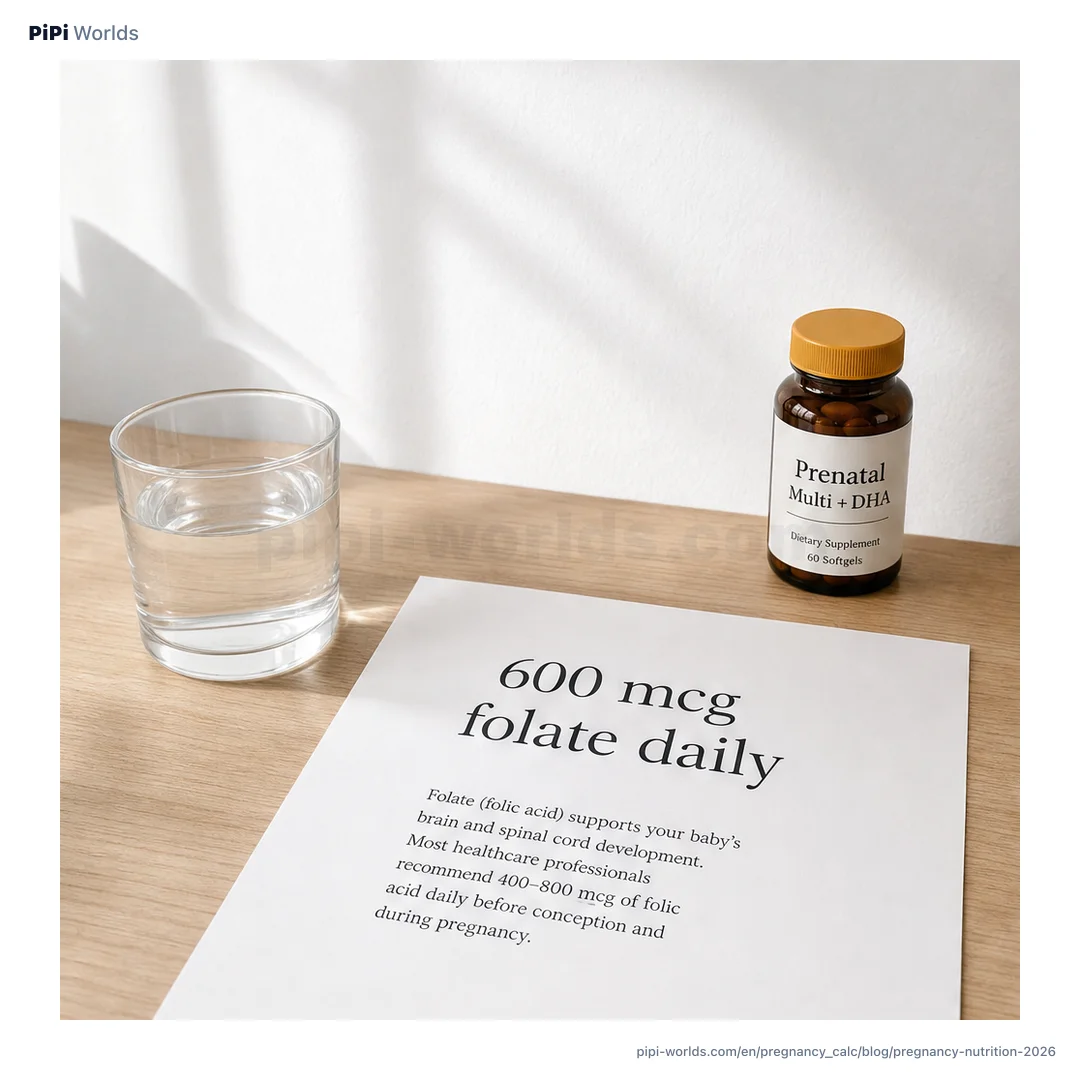
A friend in Brooklyn texted me her newly purchased prenatal vitamin bottle in early April — eight weeks pregnant, first baby, and asking the same questions every U.S. expectant parent asks somewhere between the positive test and the first OB-GYN visit. “Is 800 mcg of folic acid too much? Why does the bottle list choline at the bottom but not iodine? Can I keep eating tuna?” This guide answers those questions using ACOG, FDA, NIH, and ACOG-aligned 2024–2025 peer-reviewed updates — the U.S. authorities your OB-GYN actually references during your appointments.
Use this alongside a pregnancy week calculator so the recommendations map to your specific trimester. The math is more straightforward than the supplement aisle suggests: 600 mcg of folic acid, 8–12 ounces of low-mercury fish per week, less than 200 mg of caffeine, and a prenatal vitamin that ACOG considers “insurance” rather than the foundation.
The five nutrients ACOG flags as most important
ACOG’s “Nutrition During Pregnancy” guidance identifies a short list of nutrients that meaningfully change pregnancy outcomes when adequate or deficient.
1. Folic Acid — 600 mcg/day The only nutrient with a documented neural-tube-defect prevention effect. ACOG recommends starting at least one month before conception (when possible) and continuing through the first 12 weeks. Most U.S. prenatal vitamins contain 600–800 mcg.
2. Iron — 27 mg/day Pregnant women need nearly double the iron of non-pregnant adult women. Most prenatals include 27 mg, which is the U.S. RDA for pregnancy. Iron deficiency is the most common pregnancy nutrient deficiency. Take with vitamin C (orange juice, strawberries) and away from calcium and caffeine.
3. Calcium — 1,000 mg/day Same as non-pregnant adult women, but easier to fall short of when nausea limits dairy intake. Three servings of milk, yogurt, cheese, fortified plant milk, or calcium-set tofu cover it.
4. Vitamin D — 600 IU/day A 2024 NIH/PMC review noted vitamin D is one of the most commonly under-consumed pregnancy nutrients in U.S. populations, especially during winter months. Many OB-GYNs check 25(OH)D at the first prenatal visit and supplement if levels are low.
5. DHA Omega-3 — 200–300 mg/day Fetal brain and visual development. Two servings of low-mercury fatty fish per week (salmon, sardines) usually cover it, otherwise an algae-based DHA supplement.
CRN Foundation programming at the 2025 ACOG annual meeting also flagged choline (450–550 mg/day), iodine (220 mcg/day), lutein, zeaxanthin, and nicotinamide riboside as nutrients many pregnant Americans under-consume — choline in particular because it’s often missing or low in mainstream prenatals. Eggs (especially yolks), dairy, and fish cover most of these.
The FDA + EPA fish guidance — read this once
The single most confusing pregnancy food question in the U.S. is fish. The FDA and EPA published joint guidance recommending 2–3 servings (8–12 oz) of low-mercury fish per week during pregnancy, while strictly avoiding seven high-mercury species.
| Category | Examples | Limit |
|---|---|---|
| Avoid | Bigeye tuna, king mackerel, marlin, orange roughy, shark, swordfish, tilefish (Gulf of Mexico) | None |
| Limit | White (albacore) tuna | 6 oz/week max |
| Best Choices (8–12 oz/week) | Salmon, sardines, anchovies, light canned tuna, cod, tilapia, shrimp, scallops, pollock, flounder, herring | Eat regularly |
Why the strict avoid list:
- These species are large, long-lived, and accumulate mercury at the top of marine food chains
- Methyl mercury crosses the placenta and impairs fetal nervous system development
- The “limit white tuna to 6 oz” is because albacore is moderate mercury, while light canned tuna (skipjack) is low mercury
Salmon (wild or farmed) is the most-recommended pregnancy fish in U.S. guidance — high omega-3 DHA, low mercury, widely available. Sardines and anchovies are second-tier favorites for the same profile, often cheaper.
Prenatal vitamins — what to check on the label
A 2024 PMC analysis found that most over-the-counter prenatal vitamins do not fully meet ACOG’s micronutrient guidelines on their own. That doesn’t mean they’re useless — they reliably cover folic acid, iron, and a basic vitamin/mineral floor — but it does mean reading the label matters.
What ACOG-aligned prenatals should provide:
- Folic acid: 600 mcg minimum (most provide 800)
- Iron: 27 mg
- Calcium: 200–300 mg (rest from diet)
- Vitamin D: 600 IU
- Iodine: 150 mcg (often missing — check your label)
- Choline: ideally 450 mg (rarely included — supplement separately or eat 2 eggs/day)
- DHA: 200 mg (often sold separately)
Common U.S. brands and what to know:
- Nature Made Prenatal + DHA: covers basics + DHA, USP Verified
- OneADay Prenatal: drugstore reliable, often missing choline
- Theralogix TheraNatal: pharmacist-favored, comprehensive
- Ritual Essential Prenatal: vegan/vegetarian-friendly, includes choline
- Garden of Life mykind: whole-food-based, organic; check iron form
If your prenatal lacks DHA, choline, or iodine, those are the most reasonable add-ons. Skip “extra” mega-doses of vitamin A (retinol) — high doses are teratogenic; beta-carotene from food is fine.
A worked example — start from your last period to find the trimester
You can memorize every number above and still get stuck on the real question: what should I focus on today? That answer depends on knowing your pregnancy week first. Here’s how it plays out with a hypothetical case.
Say your last menstrual period (LMP) started January 26. Enter that date into the pregnancy week calculator and, as of today (May 19), it returns 16 weeks 1 day — the second trimester (weeks 14–27). Once “second trimester” is confirmed, the nutrition priorities in this guide narrow immediately: the most critical folic-acid window (first 12 weeks) has passed, so you keep folate going through your prenatal rather than chasing it, and the focus shifts to iron and protein as the baby grows fastest. Your ferritin gets checked at routine bloodwork, and the anatomy scan around 18–22 weeks is just ahead. If the same calculator had returned 8 weeks instead, the priority would not be iron at all — it would be folic acid and nausea management. The week sets the trimester, and the trimester sets which nutrients matter most.
What to limit, what to avoid
The U.S. avoid/limit list is shorter than the supplement list:
Strictly avoid:
- Alcohol — no known safe amount during pregnancy (CDC, ACOG)
- Raw or undercooked meat, fish, eggs (listeria, salmonella)
- Unpasteurized dairy products and juices
- Deli meats unless heated to steaming (listeria)
- Raw sprouts (alfalfa, clover, radish, mung bean)
- The seven high-mercury fish species above
Limit:
- Caffeine to less than 200 mg/day (≈ one 12-oz brewed coffee)
- Processed meats and ultra-processed foods
- Added sugars and sugar-sweetened beverages
- High-sodium foods (especially with hypertension or pre-eclampsia history)
Common myths debunked:
- Coffee is forbidden — false. Under 200 mg/day is acceptable per ACOG
- No spicy food — no medical basis. Heartburn yes, harm to baby no
- Sushi is always off-limits — cooked sushi (eel, shrimp tempura, California roll with cooked crab) is fine
- Vegetarians can’t get enough iron — not true with planning (lentils, beans, fortified cereals, spinach with vitamin C)
Trimester-specific nutrition focus
Use a pregnancy week calculator to find your current trimester, then map nutrition priorities accordingly:
First trimester (weeks 1–13) — folic acid + nausea management
- Folic acid 600 mcg (most critical window for neural tube)
- Small frequent meals if morning sickness
- Ginger tea, B6 supplement (after OB-GYN approval)
- Caffeine ≤200 mg
- See Due date + 40-week prenatal calendar for first-visit timing
Second trimester (weeks 14–27) — iron + protein + calcium
- Iron rises sharply as baby grows; ferritin checked at routine bloodwork
- Protein 71 g/day (up from non-pregnant 46 g)
- Calcium 1,000 mg/day
- Anatomy scan around 18–22 weeks
Third trimester (weeks 28–40) — glucose + blood pressure + DHA
- Glucose tolerance test at 24–28 weeks
- Blood pressure monitoring (preeclampsia screen)
- Continued DHA for late-stage brain development
- Weight-gain pacing inside the IOM band (see Pregnancy weight gain by BMI)
- See BMR after 50 / Sarcopenia for older first-time pregnancies needing nutrition adjustments
Medical disclaimer — work with your OB-GYN
This article summarizes ACOG, FDA, NIH, and Mayo Clinic guidance current as of 2026. Pregnancy nutrition decisions should be made with your OB-GYN, midwife, or a registered dietitian who knows your medical history. Pre-existing conditions (diabetes, thyroid disorders, autoimmune disease, hypertension) and high-risk pregnancies require individualized plans. Lab values from your prenatal visits (ferritin, glucose, vitamin D, hemoglobin) drive most personalized adjustments.
The bottom line — “what week am I, and which nutrient stage?”
After all the numbers, the question that actually remains is one: “What week am I today, and which nutrition stage does that put me in?” You can memorize the supplement list, but you can’t tell whether a given item is the one for your stage of pregnancy without knowing your week.
Here’s the order that resolves it:
- Enter your last menstrual period (or IVF transfer date) into the pregnancy week calculator — it returns your current week and trimester (first/second/third) in one step.
- Map that trimester onto the “Trimester-specific nutrition focus” section above — first trimester (weeks 1–13) means folic acid and nausea management, second (weeks 14–27) means iron and protein and calcium, third (weeks 28–40) means glucose, blood pressure, and continued DHA.
- Line it up with your prenatal-visit milestones — week 12 (close of the critical folate window), 18–22 weeks (anatomy scan), and 24–28 weeks (glucose tolerance test) are the inflection points. Use the calculator to see how many days until each, and pair it with the due date + 40-week prenatal calendar.
- Bring that screen to your OB-GYN — walking in with your week and trimester already fixed turns “what should I add?” into a specific, answerable question.
Folic acid, the fish list, and the avoid list are common to every pregnancy — but which item is your turn today is decided by your week. That’s why checking your week with the calculator is the starting point, not an afterthought.