
You sit for three hours and realize only thirty minutes of it was real focus. That is not a willpower failure. The brain simply struggles to stay locked on one task for long stretches. The Pomodoro Technique works with that limit instead of against it, by slicing time into short blocks of focus and rest.
Why focus falls apart, and it isn’t willpower
The longer you try to concentrate in one unbroken push, the more stray thoughts and small distractions slip in. A goal like “study for three hours” feels heavy, so you put off starting at all.
The fix begins with shrinking the goal. “Just 25 minutes, starting now” is a far smaller promise than “three hours,” and a small promise is easy to keep. Starting is usually the hard part; once you begin, focus tends to follow.
Every interruption also carries a hidden cost. When you break off to answer a message, getting back to where you were takes much longer than the interruption itself. A handful of those per hour, and the hour is gone. Fencing the work into a protected block is really a way to keep out those small, expensive breaks in attention.
The Pomodoro Technique: 25 on, 5 off
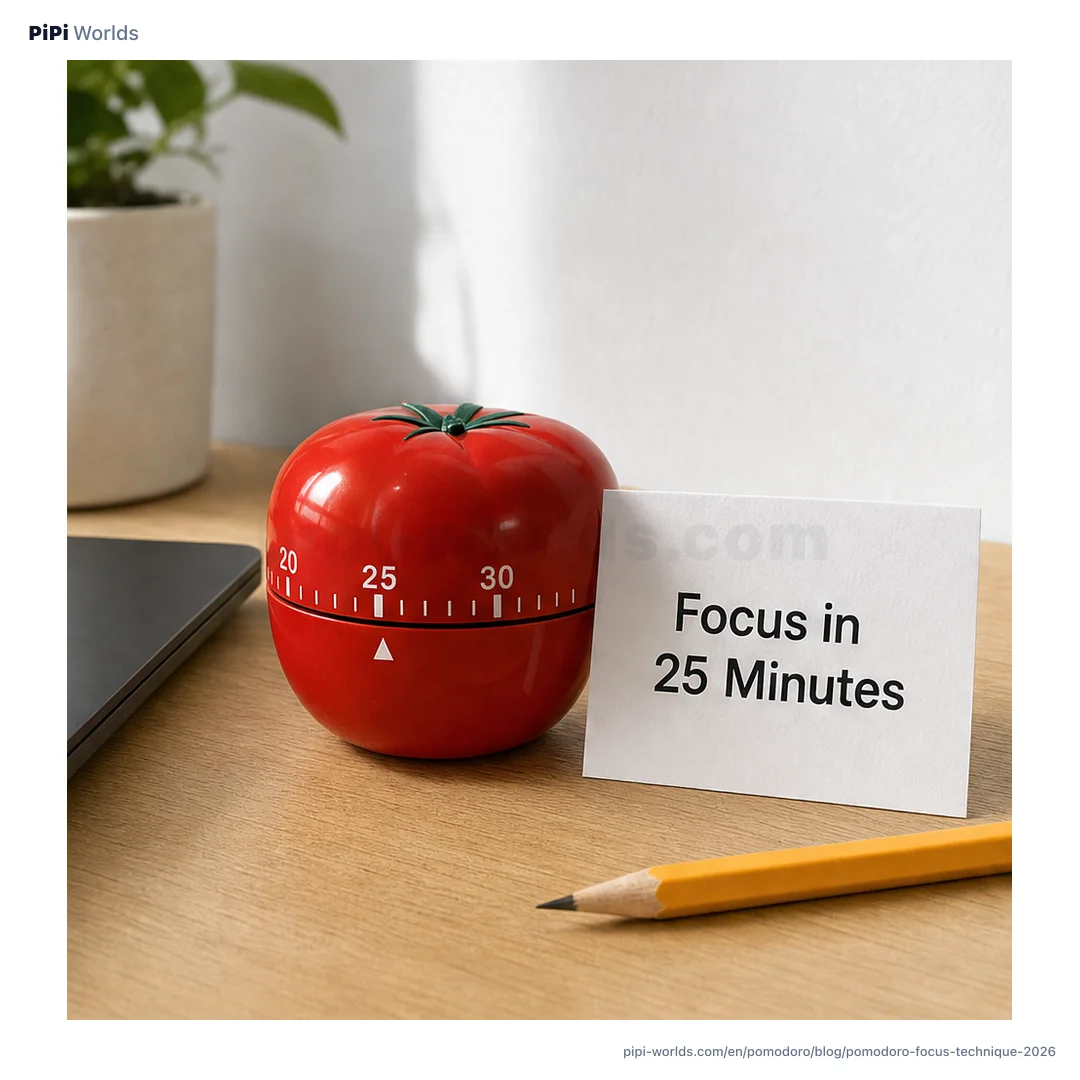
The Pomodoro Technique is a time-management method created by Francesco Cirillo in the late 1980s, named after the tomato-shaped kitchen timer he used as a student (pomodoro is Italian for tomato).
The structure is simple:
- Focus on a single task for 25 minutes. That is one pomodoro.
- Take a 5-minute break.
- After four pomodoros, take a longer break of 15 to 30 minutes.
Before the timer starts, name the one task in a sentence, so there is nothing left to decide once the block begins. The core rule is the promise that, for those 25 minutes, you do only that task. If another job comes to mind, you note it in a line and keep going rather than chasing it.
Twenty-five minutes is not sacred
The 25-minute block is a default, not a law. Matching the length to the work usually serves you better.
| Situation | Suggested focus | Break |
|---|---|---|
| A scattered day, hard to start | 15 min | 5 min |
| General study, memorization, writing | 25 min | 5 min |
| Coding, design, deep work | 45 to 50 min | 10 min |
Changing the length does not change the principle. You build one unbroken block of focus, then slot a genuine break in between.
Do not waste the five-minute break
The quality of your break sets the quality of your next block. If you open social media or the news in those five minutes, more information pours in and your brain never actually rests.
Breaks that pull your eyes off the screen work best. Stand up and drink water, look out a window, or stretch lightly. For the longer break after four pomodoros, a short walk is ideal. Treat those five minutes as the part of the method that makes the next 25 possible, not as dead time to fill.
Rewards make focus last longer
A common reason the technique fizzles is that finishing a session does nothing visible. When completing a block earns an immediate reward, starting the next one gets noticeably easier.
Habits form more easily when the payoff is immediate rather than distant. “Pass the exam in three months” is too far away to pull you to the desk right now; a reward you can see the moment a block ends sits right next to the effort. That tight loop between finishing and feeling progress is what carries a routine past the first hard week.
The PiPi Focus pomodoro timer hands you a small treasure each time you finish a focus session. A circular gauge fills as a character reacts alongside you, so you feel pulled to complete the whole block. It also keeps a count of the day’s finished sessions, turning effort into something you can see.
How students and knowledge workers use it
The same timer serves different routines depending on the work.
- Exam and certification study. Splitting subjects into 25-minute units makes the day’s load visible, as in “twelve pomodoros in a day.” For repetitive work like vocabulary review, pairing the timer with PiPi Words vocabulary practice inside 25-minute blocks keeps the rhythm steady.
- Coding and design. Use 50 minutes of focus and a 10-minute break to build genuine deep-work blocks.
- Remote work. Slice the gaps between meetings into one or two pomodoros to cut the drift that comes with an open schedule.
A quick word of caution: the technique is a frame, not a cage. If you hit a state of deep flow as the timer rings, it is fine to finish the thought before you break. The goal is protected focus, not blind obedience to a bell.
From the web to the app
Start with the free web timer to see whether 25-minute blocks suit you. It runs in your browser with no install and no sign-up.
If the loop of focus turning into a reward clicks, the PiPi Focus mobile app extends it further. You unlock ten island themes with the treasures you collect, keep a streak of consecutive focus days, and lean on ambient sounds like waves and gulls to stay immersed. Focus becomes a voyage rather than a chore.
The web timer and the app share one idea: make a single 25-minute block easy to start, then make finishing it feel good enough to do again. Stack enough of those small wins, and a focused hour stops being something you force and becomes something you come back to.