
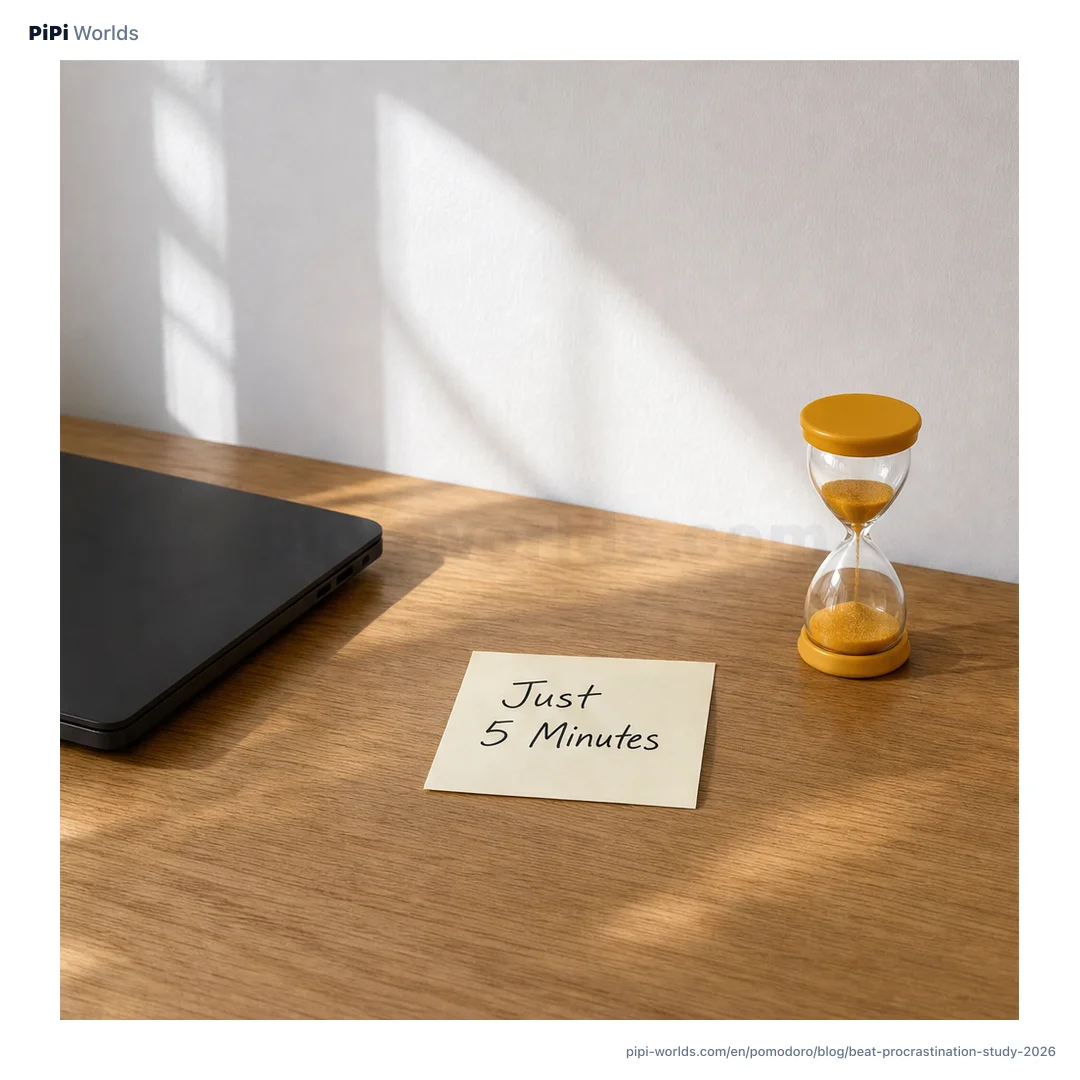
You know the work is due, yet the moment you face the desk you suddenly want to clean your room. You wait for motivation to arrive, and somehow it is bedtime and all you have to show for the day is guilt about putting it off again. Here is the reframe that helps: procrastination is not a willpower failure. It is friction at the moment of starting, and that means the place to act is the friction, not your resolve.
Procrastination is not laziness
Procrastination is the act of delaying a task even when you expect to be worse off for the delay. It is a common, well-studied human behavior rather than a character flaw or a sign of laziness.
The key detail is where it strikes: at the start. People who can study for an hour once they begin still find the five minutes before opening the book the hardest part. The bigger the goal, the larger that first friction grows. A block like “study for three hours” feels heavy, and heavy tasks keep sliding to later.
So the thing to manage is not your willpower but the threshold of beginning. Lower the threshold, and you step in even on the days your motivation is thin.
Motivation follows action, not the other way around
The common assumption is a sequence: feel motivated, then start. In practice it usually runs the other way. Movement pulls motivation in behind it. The moment you read one sentence, solve one problem, or write one line, your brain steps into the task, and only then does the “maybe a little more” feeling show up.
That means on an unmotivated day, what you need is not a pep talk but a way to make the starting action tiny. Instead of “study,” try “open the textbook and read only the first paragraph.” Shrink the first action until it is almost too small to refuse, and you can do that much even with no motivation at all.
This small start matters because once you step in, continuing becomes more natural than stopping. Clear the start barrier and the rest goes far more smoothly.
The five-minute rule: shrink the task so starting is painless
The most reliable move is to shrink the starting unit to “just five minutes” or “just ten.” Five minutes is an amount anyone can spare, so there is no reason to refuse, and once you press the timer you are at the desk. Part of why it works is that the end is in sight from the start, which keeps the promise feeling light, and that lightness is what coaxes out the first step.
Here is how to lower the start barrier for the situations that usually trip you up.
| When you stall | The first action that lowers the barrier |
|---|---|
| The workload feels too big | Drop “finish it” and set a timer for “the first five minutes” |
| You are blank on where to begin | Touch the easiest single problem or page first |
| Just opening the book is hard | Leave the book open from the night before, then walk away |
| Your phone keeps pulling you | Put the phone in another room before you start |
| Perfectionism stops you starting | Lower the bar to “a messy first draft is fine” |
The principle behind every row is the same: remove anything you would have to decide or steel yourself for once you sit down. The fewer steps a start requires, the faster the first action comes on a low-energy day.
How to structure that five-minute block into short cycles of focus and rest is covered in the guide to the 25-minute focus routine. If you want the 25-on, 5-off mechanics for holding one unbroken block once you have cleared the start barrier, read that piece alongside this one.
Once you start, an immediate reward keeps you going
Clearing the start barrier is not enough on its own, and there is a common reason routines fizzle after a few days: finishing once produces nothing visible. When the reward sits far away, like “pass the exam in three months,” it pulls far too weakly on the single block in front of you.
The fix is to attach an immediate, visible reward to finishing. When each completed block earns a small payoff right away, the act of finishing lands next to the satisfaction. That short loop between doing the work and seeing progress is what brings you back to the desk the next day.
The PiPi Focus pomodoro timer is built around exactly this point. You press a short fixed block that is easy to begin (focus of 5, 15, 25, or 50 minutes, breaks of 5 or 10), which lowers the start barrier, and each finished session hands you a small treasure right away. A circular gauge fills as a character reacts alongside you, so you feel pulled to complete the whole block. On the web it keeps a count of the day’s finished sessions, stored in your browser, turning effort into something you can see.
Designing a day that resists procrastination
Fold the same principles into a day and the putting-off shrinks.
- Decide the first block in advance. Choosing what to do the night before erases the hesitation that eats the minutes after you sit down.
- Make the first action concrete. Not “study math” but “redo the three problems I missed yesterday,” so the first five minutes are spelled out.
- Bundle repetitive work into small units. For review-heavy study like vocabulary, starting PiPi Words vocabulary practice in five-minute blocks keeps the load light.
- Leave finished blocks visible. Watching the count of completed sessions stack up gives you a reason to begin the next one.
- Do not punish a missed day. Skipping once does not break the habit. Start with just five minutes the next day and the rhythm returns. The more guilt you carry, the heavier the next start feels, so resuming plainly works better than vowing to make up for it.
Do not try to build a perfect day in one move. Beating procrastination is not a grand act of resolve; it is the sum of small devices that make starting easy. When one device works, it tends to invite the next, and the number of times you sit down quietly grows.
Five minutes on the web, the habit in the app
Start with the free web timer and begin just one block. It runs in your browser with no install and no sign-up, so the start barrier is as low as it gets. To see how a five-minute block draws out a start, read it alongside the 25-minute focus routine guide.
If the loop of starting that turns into a reward clicks, the PiPi Focus mobile app grows it into a habit. You unlock ten island themes with the treasures you collect, keep a streak of consecutive focus days, climb honor ranks, and lean on ambient sounds like waves and gulls to stay immersed. The studying you used to put off becomes a voyage you return to.