
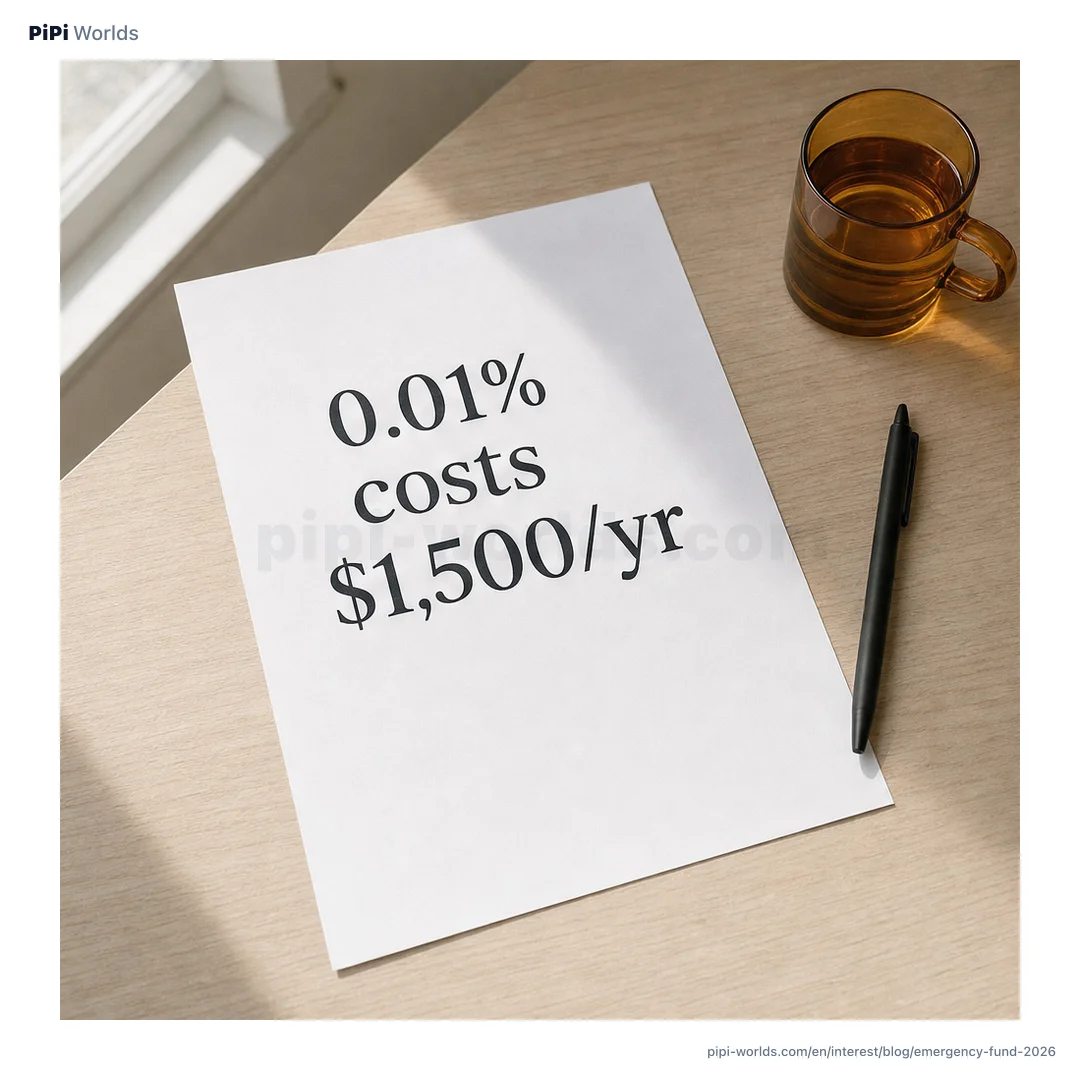
Most personal finance writers tell you to build an emergency fund of 3-6 months of expenses. Far fewer tell you specifically where to put it. The default — a checking or “regular” savings account at a major bank earning 0.01% APY — quietly costs the average emergency-fund holder over $1,000 per year compared to a high-yield savings account. On a $30,000 fund (the rough size for a household with $5,000/month essential expenses), the choice between Bank of America’s standard savings (0.01%) and a high-yield account like Marcus or Ally (5.0%) is the difference between $3 a year in interest and $1,500. Same dollar amount of safety, dramatically different returns.
How much emergency fund — and why 6 months
The CFP Board, Vanguard, and Fidelity all recommend 3-6 months of essential expenses (housing, food, utilities, transportation, insurance, minimum debt payments). The 6-month figure traces back to:
- Bureau of Labor Statistics: median U.S. unemployment duration is approximately 8-15 weeks
- Adding safety margin for unexpected medical expenses, major car/home repair, or family emergencies brings the total to roughly 6 months
A household with $5,000 in monthly essential expenses needs $15,000 (3 months) at minimum and $30,000 (6 months) at the recommended cap. Households with variable income (commission-based, freelance, contract work) often extend to 9-12 months because of higher income volatility.
The three primary options
For an emergency fund of $30,000, three options dominate in 2026:
| Option | Yield (May 2026) | Liquidity | Tax Treatment |
|---|---|---|---|
| HYSA (Marcus, Ally, SoFi) | 4.5-5.0% APY | Same-day to 1-day | Federal + state taxable |
| 4-Week T-Bills (rolled) | 4.4-4.6% | Mature 28 days | Federal taxable, state tax-exempt |
| Money Market Fund (SPAXX, VMFXX) | 4.5-5.0% | Same-day | Federal + state taxable |
For most savers in zero-state-tax states (TX, FL, NV, WA, etc.), HYSA wins on simplicity. For savers in high-tax states (CA, NY, NJ, IL), T-Bills’ state tax exemption flips the math — a 4.5% T-Bill is roughly equivalent to a 5.0% HYSA after California’s 9.3% state tax.
Calculating your effective yield in a high-tax state
Using a 24% federal bracket:
- HYSA at 5.0% APY in CA: 5.0% × (1 - 0.24 - 0.093) = 3.34% effective
- T-Bill at 4.5% in CA: 4.5% × (1 - 0.24) = 3.42% effective (state tax exempt!)
- HYSA at 5.0% APY in TX: 5.0% × (1 - 0.24) = 3.80% effective
- T-Bill at 4.5% in TX: 4.5% × (1 - 0.24) = 3.42% effective
In zero-state-tax states, HYSA wins. In high-tax states, T-Bills usually win. Either way, the difference between these high-yield options and a 0.01% bank savings account is enormous.
A laddered approach for $30K
Splitting the emergency fund across three buckets balances accessibility with returns:
- Tier 1 — Instant access ($5,000 = 1 month): Checking account or HYSA. Same-day access for routine emergencies (broken laptop, urgent travel, medical co-pays).
- Tier 2 — Short access ($15,000 = 3 months): HYSA or money market fund. 1-day access for major emergencies (job loss, medical procedure, car repair).
- Tier 3 — Best yield ($10,000 = 2 months): T-Bill ladder (1-month bills rotated every week) or 3-month T-Bills. Slightly less liquid but better yield in high-tax states.
This produces a blended yield around 4.6-4.8% APY while maintaining real-world accessibility. The interest tool lets you model this allocation by entering each tier as a separate scenario and adding them with the compare panel.
Here is a worked example to make it concrete. Park the full $30,000 in an HYSA at 5.0% APY for one year and the pre-tax interest is $30,000 × 5.0% = $1,500. In a zero-state-tax state at a 24% federal bracket, the after-tax interest is $1,500 × (1 − 0.24) = $1,140, and the balance after one year is roughly $31,140. Leave the same $30,000 in a 0.01% checking account and the after-tax interest is about $2 — a gap of roughly $1,138 a year for the exact same dollar amount of safety. Flip the interest tool’s before-tax/after-tax toggle and enter your principal, rate, and term to get this maturity figure and after-tax interest in one shot.
When to NOT max out emergency fund
Two scenarios where conventional emergency-fund advice misleads:
1. High-interest debt outstanding. A starter $1,000-$2,000 emergency fund, then aggressive payoff of debt above 15% APR (most credit cards), then full emergency fund. Reasoning: paying off 22% credit card debt provides a guaranteed 22% return, dramatically better than HYSA’s 5%.
2. Roth IRA contributions as a super-buffer. Roth contributions (not earnings) can be withdrawn anytime tax/penalty-free. Some savers stop building emergency fund at 3 months and use Roth contributions as the next layer of buffer. The advantage: any unused emergency capacity stays invested at higher returns. The downside: 1-3 day liquidity (not instant) and depleted retirement capacity if used.
Beyond 6 months — the opportunity cost trap
Holding 12-24 months of emergency fund seems “extra safe” but creates real opportunity cost.
| Emergency fund | HYSA 5% earns | S&P 500 7% historical earns | Difference |
|---|---|---|---|
| 6 months ($30K) | $1,500 | $2,100 | -$600 |
| 12 months ($60K) | $3,000 | $4,200 | -$1,200 |
| 24 months ($120K) | $6,000 | $8,400 | -$2,400 |
After 6 months of expenses, additional money belongs in retirement accounts (401k, IRA, Roth IRA) and taxable index investing. The “lost” yield in HYSA compounds over decades to substantial amounts. The CFP Board, Vanguard, and Bogleheads forums all converge on: don’t exceed 6 months in cash unless you have specific volatility reasons (irregular income, near-term job concerns, etc.).
Where should your fund live — and what does that cost you after tax?
The question that actually decides this isn’t abstract: where do I put my own emergency fund, and how many dollars after tax does the choice change? That is not a math problem to solve in your head — it is a problem you finish by typing numbers into the interest tool.
The sequence is short. (1) Lock your fund size: monthly essential expenses × 6 — $5,000/month means $30,000. (2) Enter principal $30,000 and a 1-year term into the interest tool and turn the after-tax toggle on. (3) Change only the rate to stack comparison scenarios — 0.01% checking, 4.5% T-Bill, 5.0% HYSA, 5.0% money market fund. The compare panel then lines up, in one table, that the same $30,000 produces about $2 after tax in checking versus roughly $1,140 in a 5.0% HYSA at a 24% federal bracket. One row of difference — the “where” — is worth over a thousand dollars a year.
To pressure-test the high-tax-state case, run the T-Bill scenario too: a 4.5% T-Bill skips state tax, so in California (9.3% state) it can edge out a 5.0% HYSA after tax. Enter each ladder tier as its own scenario and add them to see the realistic ceiling on the after-tax yield you can earn without giving up liquidity.
The emergency fund’s real value isn’t its return — it’s its option value. Having $30K accessible in 24 hours buys you the freedom to walk away from a toxic job, take a family medical leave, or refuse to use a high-interest credit card during a crisis. The “earn $1,500 instead of $3” math matters, but the deeper return is the freedom that comes with the funds being there in the first place. Still, when the safety is identical, pick the row that pays you the larger after-tax number — and that row only shows up once you put the numbers into the tool.