


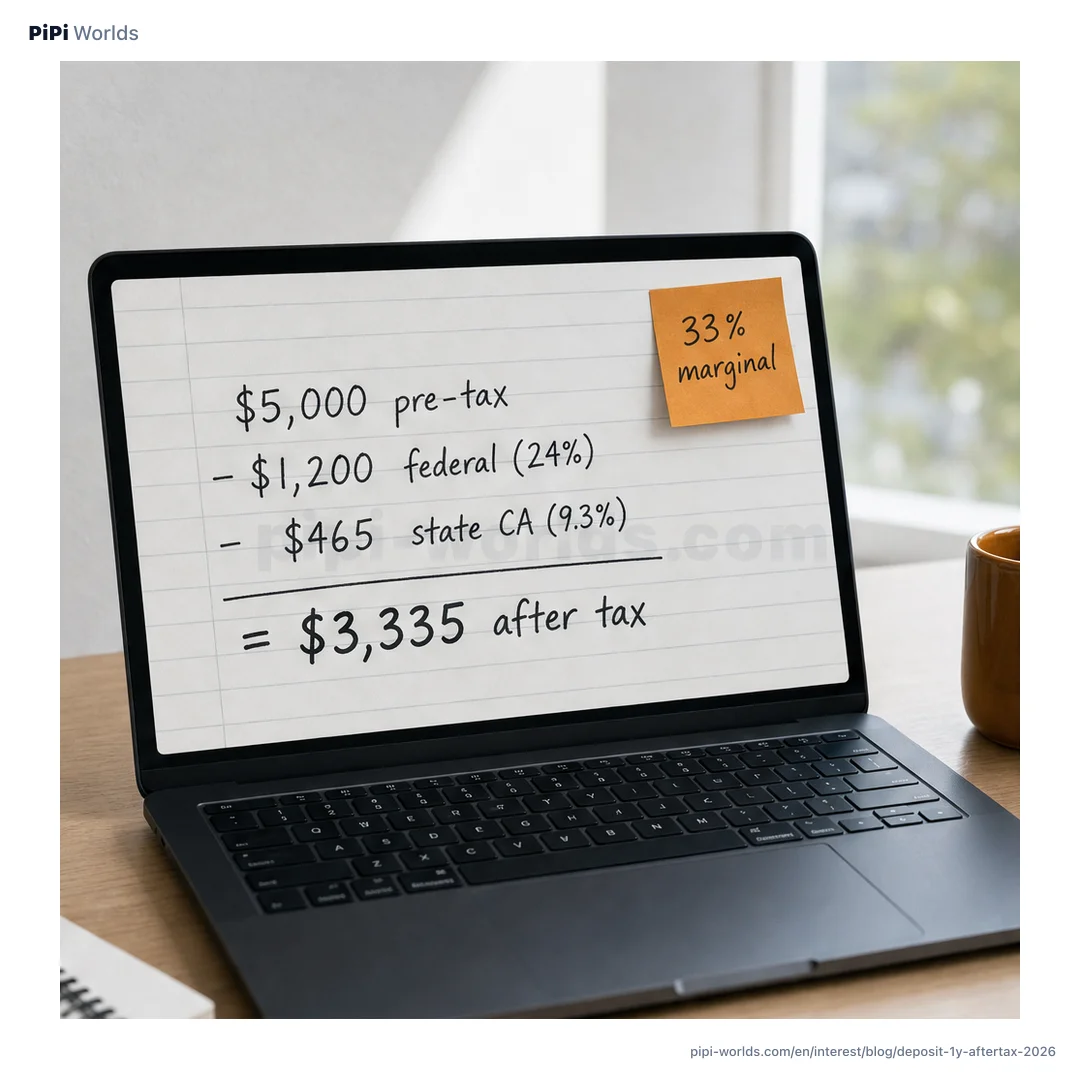
A Treasury bill can have a tax advantage over a savings account without being the better deal. The rate matters too. Here is a deliberately hypothetical, one-year comparison that shows how close the answer can be: $100,000, a savings account earning 5% APY, and a bill producing $4,500 of interest on the same $100,000 outlay. Those are teaching inputs, not September 2026 rates or offers.
The result in the California example is an $85 difference, not a multi-point windfall. You get that answer only by comparing after-tax dollars with after-tax dollars.
One year, the same $100,000 outlay
Assume the additional interest falls in a 24% federal marginal bracket. For the California illustration, also assume a 9.3% state marginal rate. These are inputs to the example, not a claim that every California resident pays those rates or that a 2026 bracket has been verified for you. The California FTB’s posted 2025 schedule shows a 9.3% bracket; check the applicable tax year’s schedule before using your own rate. The no-state-income-tax illustration uses a 0% state rate.
California illustration — 24% federal plus 9.3% state:
- HYSA: $5,000 gross interest − $1,200 estimated federal tax − $465 estimated state tax = $3,335 after tax.
- Treasury bill: $4,500 gross interest − $1,080 estimated federal tax − $0 state income tax = $3,420 after tax.
No-state-income-tax illustration — 24% federal:
- HYSA: $5,000 gross interest − $1,200 estimated federal tax = $3,800 after tax.
- Treasury bill: $4,500 gross interest − $1,080 estimated federal tax = $3,420 after tax.
So the bill is ahead by $85 in the California illustration ($3,420 − $3,335). Where the state rate is 0%, the savings account is ahead by $380 ($3,800 − $3,420). The corresponding California after-tax yields on the initial $100,000 are 3.335% and 3.42%—a gap of 0.085 percentage points. This simplified calculation does not include other taxes, deductions, fees, changing rates or selling a bill before maturity.
Bank interest and Treasury-bill interest are generally subject to federal income tax. IRS Topic 403 says Treasury-bill interest is exempt from state and local income taxes; bank interest generally is not. The bank may credit the gross $5,000 of interest to the account. The $3,335 is estimated economic proceeds after a later tax liability, not the amount guaranteed to appear as an interest credit on your statement.
The comparison error to avoid
Dividing the bill’s 4.5% pre-tax return by (1 − 0.24) gives about 5.92%, but that is not its after-tax yield. Comparing that 5.92% with the bank’s 3.335% after-tax yield mixes different bases and invents a 2.6-percentage-point advantage.
Instead, apply each product’s taxes to its own gross return:
- Savings, California illustration:
5% × (1 − 0.24 − 0.093) = 3.335%. - Bill:
4.5% × (1 − 0.24) = 3.42%. - Break-even savings APY in this illustration:
3.42% ÷ (1 − 0.24 − 0.093) ≈ 5.13%. Above that assumed bank APY, the bank would overtake the assumed bill return, other things equal.
The rates in these formulas are marginal-rate assumptions, not your average tax rates. They omit tax interactions that can change an individual’s final liability. Use your own situation rather than treating 3.335% or 5.13% as a universal threshold.
A bill’s quoted discount rate is not a savings APY
The $4,500 bill return above is a simplified one-year cash-return assumption. It is not a claim that a bill auction currently offers a 4.5% rate. Treasury bills are usually bought below face value; the difference between the price paid and face value at maturity is the interest. TreasuryDirect’s pricing guide explains that mechanism. Its investor guide distinguishes the bill’s face-value, 360-day discount rate from its purchase-price, 365/366-day investment rate. A bank APY includes compounding. To compare a real offer, use the bill’s actual price, maturity date and proceeds, then put its return and the bank’s return on the same holding-period and after-tax basis. Rolling shorter bills introduces reinvestment-rate uncertainty; selling before maturity introduces market-price risk.
What the PiPi calculator can—and cannot—check
Use the interest calculator with the following hypothetical inputs, rather than your personal account details. Inputs appear in the calculator URL.
- Choose Savings, then HYSA.
- Set Principal / Lump sum to 100000 and Monthly contribution to 0. The default monthly contribution is 500; leaving it there adds $6,000 of deposits and changes the interest, so it is not this lump-sum comparison.
- Set APY to 5% and Term to 12 months.
- Enable After-tax, then enter Federal marginal 24% and State marginal 9.3%.
Read After-tax interest: $3,335.00. The before-tax interest is $5,000 and modeled tax is $1,665; Balance after modeled tax: $103,335.00 includes the original $100,000. Changing only the state rate to 0% gives $3,800.00 after-tax interest and $103,800.00 including principal.
The savings formula subtracts (federal + state) × gross interest once at the end. Schedule and CSV balances remain before modeled tax; they are not the after-tax balance. This is an estimate, not a tax return, annual tax-payment model, or forecast of rates.
There is no Treasury-bill product or live auction feed in this calculator. To isolate the tax difference, you can make a separate, clearly labeled proxy scenario using 4.5% as an assumed one-year savings return with state rate 0%. It returns $3,420 after the assumed federal tax, but it does not price or purchase a bill. Do not type a bill’s auction discount rate into the APY field and treat the output as its actual yield.
If you are considering a CD instead, verify the bank’s early-withdrawal terms. The current form assumes the full original term and has no early-withdrawal month or penalty input. It does not calculate an early-exit payoff, replacement CD, or complete break-even cash flow. Some CDs do not allow additional deposits. Check the actual contract rather than treating this savings model as a CD exit quote.
October 13, 2026 correction: added the missing zero-monthly-contribution step and removed an outdated claim that the visible calculator estimates CD early-withdrawal penalties. The three hypothetical after-tax interest results were checked in the public calculator using AI assistance; this was not a new review of tax brackets, current offers, or an individual contract. The official-source review above remains dated September 28.
Decision rule: collect dated offers, match the holding period and access to cash, compare net dollars under your own tax assumptions, and check the actual product terms. The tax exemption alone does not decide the winner.