
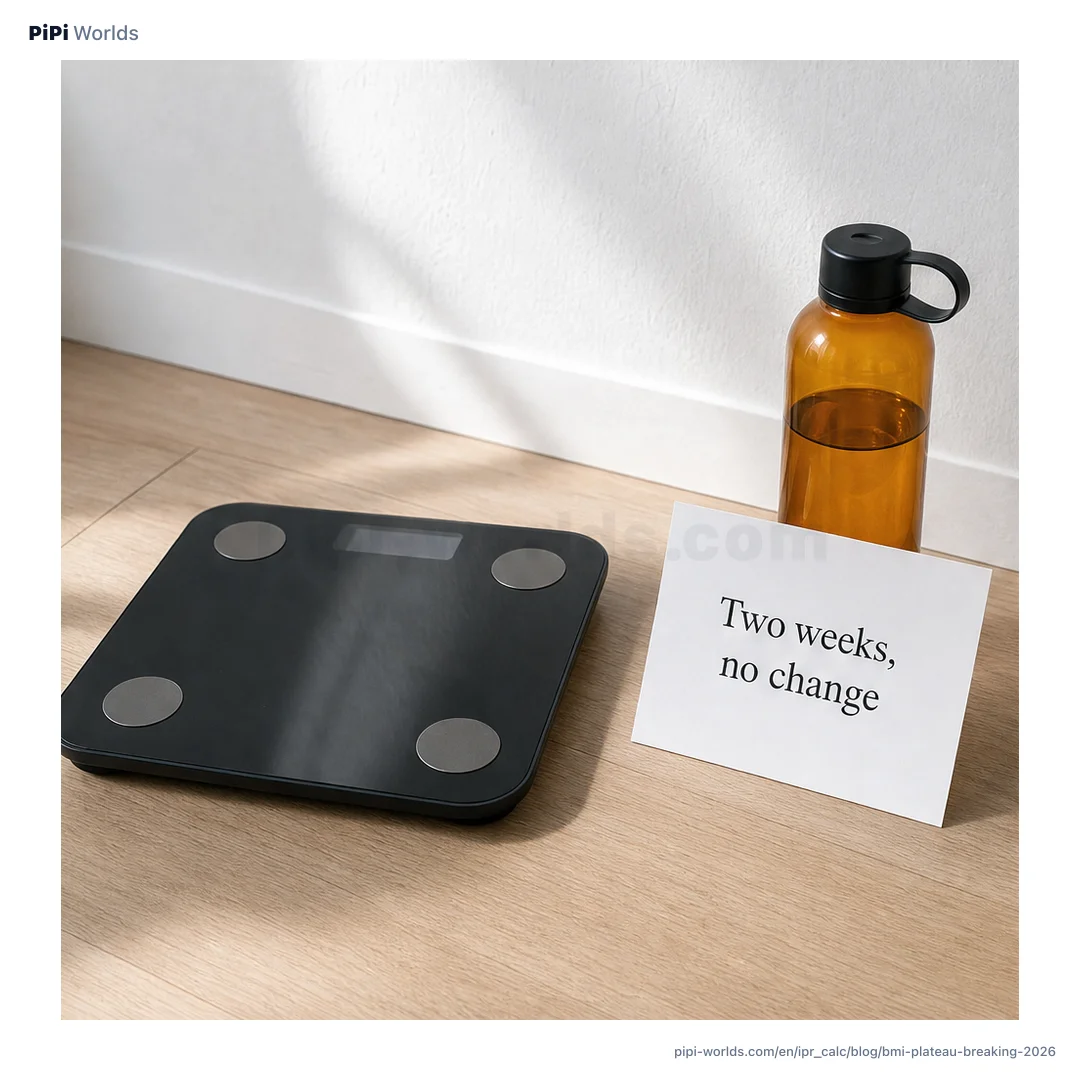
A friend of mine — a software engineer in Austin — sent me his Renpho scale screenshot in late April. “Three weeks, same weight. Same calories, same workouts, nothing’s moving.” That’s the moment every disciplined dieter eventually hits: the scale stops, the protocol that was working stops working, and the immediate temptation is to slash calories deeper. That’s almost always the wrong move.
The plateau isn’t failure. After losing roughly 5–10% of starting body weight, the body shifts into a defensive posture — metabolic adaptation, dropping NEAT, and falling thyroid hormones — that quietly recalibrates “calories out” downward. By the time you’ve lost 16%, that adaptation is loud. The 2025 NCBI StatPearls review on weight-loss plateau management calls this an expected stage, not a setback. This piece is a research-backed reset for U.S. readers — what to actually do during the two-week stall, in roughly the order of impact.
Why progress stalls — four mechanisms working at once
Four interlocking forces produce the plateau.
1. BMR adaptation downward. As body weight drops, basal metabolic rate drops with it, faster than the simple math of weighing less would predict. The “1,800-calorie maintenance” you started with at 200 lb is no longer 1,800 calories at 180 lb — and the difference compounds.
2. NEAT decline. When intake drops, your body unconsciously moves less. Standing time falls, fidgeting drops, posture loosens, you take fewer “extra” steps. The published spread between high-NEAT and low-NEAT individuals can hit 500–800 kcal/day. NEAT is the single largest, most invisible energy buffer most dieters lose.
3. Hormonal adaptation (leptin and T3 down). Sustained restriction lowers leptin (satiety hormone) and T3 (active thyroid hormone). The result is exactly the texture of a plateau: hungrier than before, while results slow. Refeed-day studies show T3 can rebound 15–20% within two to three days of a single high-carb day.
4. Training habituation. A program that creates a stimulus in week 1 creates much less stimulus in week 8. The same calories burned in the same workout meet a body that has gotten more efficient at doing exactly that work.
The conclusion across modern obesity research and fitness practitioners is the same. Don’t cut deeper. Reset the inputs.
Step 1 — Recalculate TDEE for the body you have today
Most plateaus include the same hidden mistake: calorie targets set for the starting weight, never updated. If you’ve lost 10 pounds, your maintenance calories are several hundred lower than they were when you started. Hitting the same number now is a deeper deficit than you intended.
Use a BMI / BMR / TDEE calculator to recompute against current body weight, then set deficit at 15–20% — the upper end is for advanced dieters with significant muscle. The full Mifflin-St Jeor and activity-multiplier walkthrough is in our BMI/BMR/TDEE diet-start guide.
Step 2 — Hit a real protein floor (1.2–1.6 g/kg)
The standard RDA of 0.8 g/kg/day is a deficiency-prevention number, not an optimization number for someone losing weight. During a deficit, peer-reviewed reviews and ACSM-aligned guidance recommend 1.2–1.6 g per kg of body weight per day to preserve lean mass. For a 70 kg adult that’s 84–112 g per day, distributed roughly evenly across meals.
Practical U.S. examples per meal hitting ~25–30 g protein:
- Breakfast: 3 eggs + Greek yogurt
- Lunch: chicken bowl (4–5 oz chicken) + black beans
- Dinner: 5 oz salmon + cottage cheese side
- Snack: protein shake or 1 cup Greek yogurt
Plateaus dissolve faster when protein floor is met every meal, not just totaled across the day.
Step 3 — Rotate the training stimulus
A program that was challenging in week 1 has been “solved” by week 6. Plateau breakers, in order of effort:
| Current pattern | Switch to |
|---|---|
| Steady-state cardio only | Add 2 strength days/week |
| Same lifts, same weight | Increase load 5–10%, drop reps |
| Long steady runs | Replace one with intervals (30s hard / 90s easy × 10) |
| Same gym layout | Rearrange order, change exercise selection |
| 4 weeks same program | Plan a deload + new block |
The strongest single intervention is usually adding resistance training if you weren’t doing it. Muscle is metabolically active and protects BMR during a deficit — it’s the primary defense against the BMR-drop spiral.
If you’re working with a coach or PT, share your TDEE recalculation and current macros explicitly. Our PT-prep BMR guide covers what to bring to that conversation.
Step 4 — Recover NEAT before adding workouts
NEAT is the quiet lever. Before you book a second daily workout, pay back the daily-life movement you’ve been losing.
A simple framework that works for most U.S. desk-job dieters:
- Step floor — 8,000 daily steps minimum during the reset, 10,000 if you can
- Standing every hour — set a recurring reminder; one minute of standing or walking
- Walking call — for any meeting that doesn’t need a screen, take it on a walk
- One commute swap per day — park further out, get off transit a stop early, take stairs
These don’t show up in a workout log but materially close the energy gap. Apple Watch, Garmin, and Whoop all surface step count and active minutes for free, no extra subscription needed.
Step 5 — Programmed refeeds, not “cheat days”
Cheat day is a cultural term. Refeed day is a programmed nutritional intervention. The difference matters: a refeed is matched to your training cycle, mostly carbohydrate, and lasts one day.
The research consensus across NCBI StatPearls, NASM, and Healthline reviews points the same direction — refeed groups preserve more lean mass and report better adherence than continuous deficit dieting. A widely cited 16-week trial reports approximately 2.1 kg better lean mass preservation in the refeed group; the absolute number varies by sample and design, so treat it as directional rather than precise. Mechanistically, a refeed nudges T3 (thyroid hormone) up 15–20% for two to three days, partially countering diet-induced metabolic slowdown.
⚠️ For readers 55+: If a primary care doctor has flagged sarcopenia, bone density, or you’re on metabolic medications (GLP-1 agonists, statins, thyroid), loop them in before changing macros or starting refeed days. Our BMR After 50 / Sarcopenia guide covers older-adult considerations in depth.
Practical implementation:
- Frequency: once per week, on the highest-training day
- Composition: bring carbs to maintenance level (or slightly above), keep protein steady, keep fat lower
- Duration: one day, not a weekend
- Expect: 0.5–1 kg scale rebound the next morning (water + glycogen, not fat) — gone in 2–3 days
A refeed is a tool, not a permission slip. Two refeeds a week stops being a refeed and starts being a maintenance week — which is sometimes the right move (a planned diet break) but should be deliberate.
Reading the smart scale during a plateau
Withings Body+, Renpho, Hume, and similar BIA-based smart scales all share the same constraint: they estimate body composition rather than measure it directly. Withings Body+ has tested at roughly ±0.8% body fat consistency in 2026 reviews; Renpho lands closer to ±2.3% versus DEXA reference; Hume Body Pod claims 98% DEXA correlation per its testing. All of them shift day-to-day with hydration, recent meals, foot dryness, and time of day.
What that means during a plateau:
- The scale being flat is not enough information
- Body fat trending down + skeletal muscle trending up = recomposition (good)
- Read the 14-day moving average, not any single morning
- Standardize conditions: same time, post-bathroom, pre-coffee, dry feet
- One tool consistently used beats DEXA-quality measurement done irregularly
For a deeper smart-scale and DEXA comparison, see our body-composition tracking guide (linked when published).
The bottom line — a five-step reset
Two weeks at the same scale weight is a signal, not a verdict. The reset, in order:
- Recalculate TDEE for your current weight via the calculator
- Hit a real protein floor — 1.2–1.6 g per kg, distributed across meals
- Rotate training stimulus — change one input, especially adding resistance work
- Recover NEAT — 8,000+ daily steps and hourly movement
- Add one programmed refeed per week on your highest-training day
The pattern across modern obesity science and serious coaching practice is consistent: plateaus break through reset, not through deeper cuts. Trust the 14-day average, trust body composition trends over scale weight, and give the protocol four weeks to register before adjusting again.