
If you’ve ever been invited to a Korean grandmother’s 70th birthday or a Japanese father-in-law’s 60th, you may have wondered why the family treats it as the social event of the year. Western culture marks 50, 65, and 100 as milestone ages, but East Asia has built a more elaborate system: at least eight named celebrations spanning 60 through 100, each with its own color, character pun, and gift conventions. Once you understand the logic, the entire calendar of family obligations starts to make sense — and the gifts become much easier to choose.
Why 60 — and what makes it different from a Western 60th
The 60-year cycle in East Asian tradition is not arbitrary. It comes from the Chinese sexagenary system, which pairs ten Heavenly Stems with twelve Earthly Branches to produce 60 unique year-names. Year 1 is jiazi, then yichou, then bingyin, and so on through guihai before the cycle returns to jiazi. A person born in a jiazi year doesn’t see another jiazi year until age 60.
Reaching 60 therefore traditionally meant returning to your starting point — a complete rotation of cosmic time. The cultural weight of this is hard to translate. The closest Western analog might be a “Saturn return” in pop astrology, but multiplied by the entire culture’s calendar, philosophy, and ritual life.
The names reflect this:
- Korean: hwangab (환갑·還甲) — “returning to jia”
- Japanese: kanreki (還暦) — “returning to the calendar”
- Chinese: huan li (还历) or liushi dashou (六十大寿) — “returning calendar” or “60th great birthday”
A Western 60th is often a single dinner. An East Asian 60th can fill a banquet hall, with multiple generations giving formal toasts in birth order, photographs that families will reference for decades, and traditional clothing if the celebrant requests it.
The eight named milestones, decoded
The full sequence is built on character decomposition — a literary game in which each milestone’s Chinese character can be broken into the year it represents.
| Age | Korean | Japanese | Character logic | Color |
|---|---|---|---|---|
| 60 | 환갑 hwangab | 還暦 kanreki | Returns to start of 60-year cycle | Red |
| 70 | 고희 gohui | 古希 koki | ”Rare since old times” (Du Fu poem) | Purple |
| 77 | 희수 huisu | 喜寿 kiju | Cursive 喜 looks like 七十七 | Purple |
| 80 | 팔순 palsun | 傘寿 sanju | Abbreviated 傘 reads 八十 | Yellow / gold |
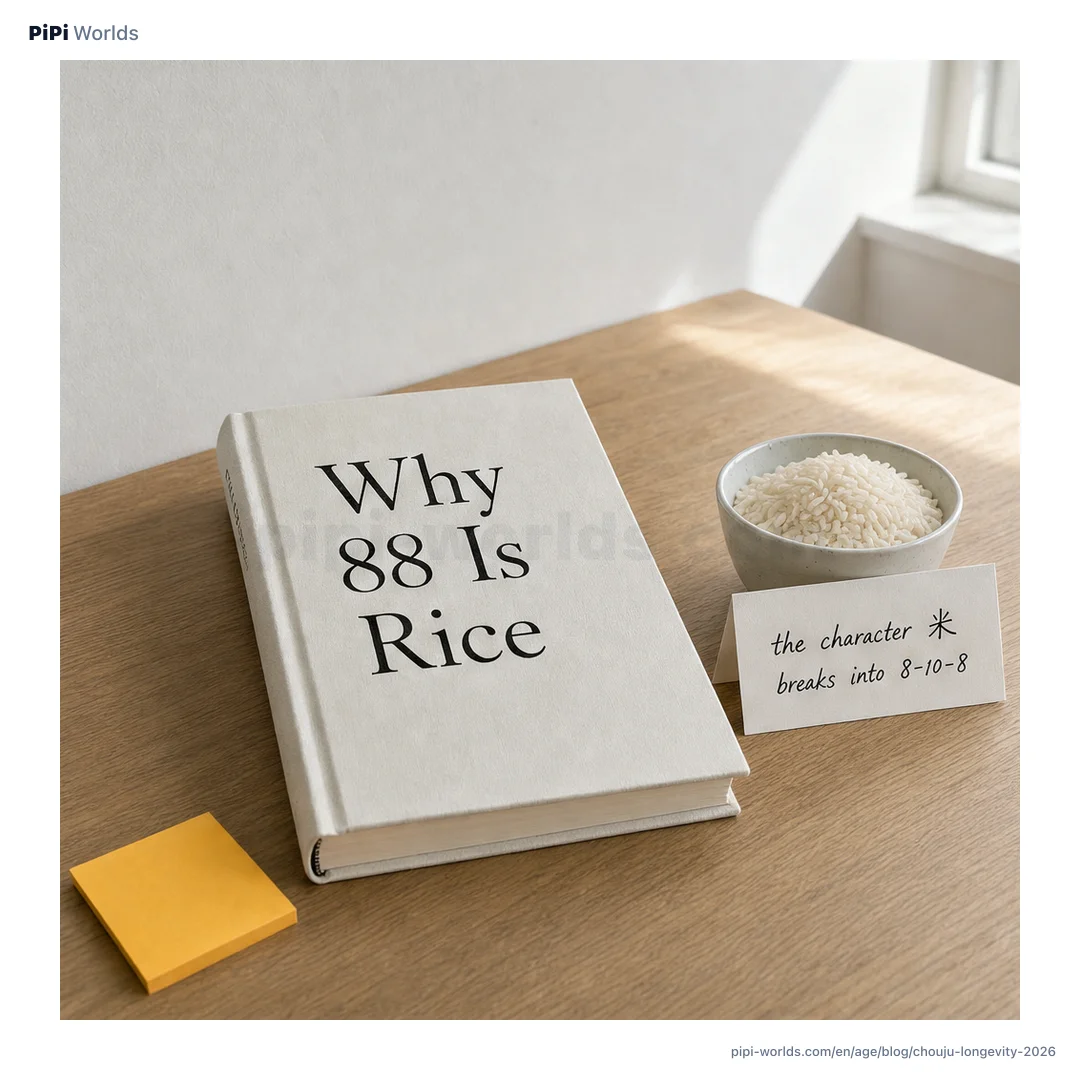
| 88 | 미수 misu | 米寿 beiju | 米 = 八十八 (eight-ten-eight) | Gold / rice color |
| 90 | 구순 gusun | 卒寿 sotsuju | Variant 卆 looks like 九十 | White |
| 99 | 백수 baeksu | 白寿 hakuju | 百 minus 一 = 白 | White |
| 100 | 백수 / 百壽 | 百寿 hyakuju | Centennial | White / pink |
The Japanese system is the most fully elaborated, with all eight stops marked. Korean tradition foregrounds 60 (hwangab), 70 (gohui or chilsun), 80 (palsun), and 88 (misu). Chinese tradition adds 大寿 (“great birthday”) at the 60, 70, and 80 marks while sharing 米寿 and 白寿 with Japan.
The character-puns are part of the literary fun. The 88 = rice (米) decomposition is widely referenced even outside formal contexts; many Japanese and Korean rice products feature the character on packaging during the gifting season. The 99 = white (白 from 百 minus 一) is a more subtle reference, often appreciated by literary-minded grandparents who recognize the wordplay.
What to wear, what to bring, what to say
If you’re invited to a Korean hwangabyeon or Japanese kanreki celebration, the etiquette has loosened over the past two decades but still has center.
Dress code. Modern celebrations vary widely. The celebrant may wear traditional clothing (Korean hanbok, Japanese montsuki or formal kimono); guests typically wear business formal in Korea, slightly more relaxed in Japan. For a 60th, including something red or burgundy in your outfit signals respect for the symbolism. For an 88th (米寿), gold or amber accents work the same way.
Gifts.
- Korean hwangabyeon (60th): White envelope with the character 壽 brushed on the front, containing crisp bills in amounts ending in 0 (50,000 / 100,000 / 200,000 KRW depending on relationship). Cash is the standard; carrying a wrapped object is unusual unless you’re the immediate family.
- Japanese kanreki (60th): Red items are still a thoughtful frame. Common gifts include a chanchanko (red vest), a quality wooden hand-mirror, or a personalized item with the recipient’s name. A handwritten card matters more than the price.
- Korean misu / Japanese beiju (88th): Items featuring rice, premium rice gift sets, or yellow-toned objects (gold tea set, brass keepsake). Family photo books are particularly valued at 88 and beyond.
Greetings. A simple “Wishing you a long, healthy life” works in any of the three languages when translated to local greeting form. Avoid the literal English “Happy Birthday” — at these milestones, the cultural register is closer to “ceremony” than “birthday party.” Korean: jang-su-haseyo (장수하세요). Japanese: o-genki-de-nagaiki-shitekudasai (お元気で長生きしてください). Chinese: shou-bi-nan-shan (壽比南山, “may your longevity exceed Mount Nan”).
When age systems get tangled
Both Korea and Japan historically used East Asian counting age, where everyone turns 1 at birth and adds a year each Lunar (or solar) New Year. A Korean grandfather born December 30 was counted as 2 years old on January 1 — at less than a week of physical age.
The transitions to international age happened on different timelines:
- Japan unified to international age in 1950 (Toshi no Tonaekata ni Kansuru Hōritsu).
- Korea passed the Age Unification Act on June 28, 2023.
- China unifies in formal/legal contexts but retains counting age (xusui) in family conversation, especially for grandparents.
This creates real ambiguity for a 60th celebration. A Korean family elder might consider hwangab to be at international age 59 (counting age 60), while younger family members default to international 60. Japanese families almost always use international 60 in modern practice but may opt for traditional age (kazoedoshi, equivalent to counting age) at certain shrines. The safe move is to ask your inviting family member: “Are we celebrating by international age or counting age?” Nobody minds the question; it shows you respect that there is, in fact, a question.
Putting numbers on it makes the gap concrete. Take a grandfather born September 20, 1955, and look at him on May 19, 2026. His birthday this year hasn’t arrived yet, so his international age is 70 and his counting age is 72. A family celebrating by international age would treat gohui / koki (70) as falling in 2026 — proper once the September 20 birthday passes. A family that keeps counting age would have marked the 70th at counting age 71, which lands in 2025 — already done. Same person, same chart, two different years, depending only on which system the family uses. Drop that birth date into the age tool and international age, Korean counting age, and Japanese kazoedoshi all appear side by side, so the family can settle which number the conversation is using before anyone books a venue.
How to use the age tool to plan ahead
The age tool is designed to handle exactly these multi-system queries. Enter a birth date and it returns:
- International age (the standard “number of completed years”)
- Korean traditional age (counting from 1 at birth, +1 each January 1)
- Japanese kazoedoshi (counting age, +1 each January 1)
- The next East Asian longevity milestone with the years remaining
For example, a grandmother born March 12, 1953, on May 3, 2026: International age 73, Korean age 74, Japanese kazoedoshi 74. The next milestone in the longevity chart is kiju (77) in May 2030, four years away. That four-year window is exactly the kind of planning horizon that makes booking a banquet hall, traveling family members, or commissioning a calligraphy gift feasible.
So: this year or next year?
The single question that stalls family group chats is whether the milestone falls this year or next — and it almost always comes down to two variables: which age system the family counts by, and whether the birthday has already passed this calendar year. The age tool settles both at once. Enter the celebrant’s birth date and it shows international age, Korean counting age, and Japanese kazoedoshi together, plus the next named milestone and the years remaining. If the international-age and counting-age numbers put the milestone in two different years, you can see the one-year gap as a number rather than argue it out from memory. Paste the result link into the family thread and everyone is reading the same figures — turning a recurring “is it this year?” debate into a one-minute decision.
A timing strategy worth borrowing
Even if you’re not from an East Asian family, the named-milestone system has practical merit. By naming 60, 70, 77, 80, 88, 90, 99, and 100, the culture creates eight clear coordination points where extended family is socially obligated to gather. In a generation when family members live far apart, that obligation produces the gathering.
Many Western families now intentionally adopt fragments of the system: a “60th” with red accents, an “88th rice birthday” because the host enjoys the cross-cultural reference, a “100th” with white flowers because Grandma grew up in California but appreciated her Japanese-American neighbors’ wisdom. The named milestones travel surprisingly well across cultures. Once you know the character behind 米寿 or the cycle behind hwangab, the celebration shifts from “exotic” to “thoughtful.” That’s exactly what these traditions, built up over centuries, were designed to do.